The Littlest Lady with the Biggest Heart

November 23, 2011

For a striking example of what One-Woman-Power can accomplish, come to Formosa and see Lillian Dickson in action! Condensed from Christian Herald

by Clarence W. Hall

A few years ago the Board of Foreign Missions of the Presbyterian Church in Canada heard curious reports about the wife of one of its ablest missionaries on Formosa. Lillian Dickson, whose husband is Dr. James Dickson, principal of Taiwan Theological College, had been going about the island cutting official red tape, snatching boys from prison and girls from parents who were selling their daughter into prostitution. She was also reported to be traipsing off into primitive regions to visit aborigines who are only a step removed from headhunting. And she spent much time rehabilitating victims of Hansen’s disease, and establishing orphanages and churches all over the island.

It was not that the Board disapproved of such a spate of good works. It was simply that they were being performed by the wife of one of the Board’s missionaries — without the Board’s approval, guidance or support.

Queried about her activities, Lil Dickson drew herself up to her full five-foot-minus height, pleaded guilty to wanton compassion. “But what would you do,” she demanded, her blue eyes flashing, “if God pushed you as He’s pushing me?”

Board members closed the fractured rule book and agreed: “What a woman!”

Formosans call her the “littlest lady with the biggest heart.” Says Hollington K. Tong, former Nationalist Chinese ambassador to the United States, “Christianity’s leaping growth in Taiwan, tenfold since 1945, is largely due to the tireless woman who can’t say no to human need.”

Lillian Dickson had not planned to be a missionary. Daughter of a flour-and-feed-mill operator in Prior Lake, Minn., she looked forward to a newspaper career. Then, at Minnesota’s Macalester College, she fell in love with a classmate, and ex-cowboy from South Dakota named Jim Dickson, who wanted to be a minister. By 1927, following Jim’s graduation from Princeton Theological Seminary, the Dicksons were on their way to Formosa. Save for brief furloughs and the World War II years, they have been there ever since. For 19 years Lillian Dickson played the role of “proper” missionary wife — tending her home, raising her two children.

The Japanese, who had held Formosa since 1895, permitted missionaries to conduct schools and hospitals, but they frowned on attempts to convert the people to Christianity. Completely closed to missionaries were Formosa’s mysterious mountains, ranging up to 14,000 feet, where lived some 150,000 fiercely independent aborigines of obscure origin.

Especially savage was the heavily tattooed Tyal tribe, 35,000 strong, who occupied the peaks and gorges of north-central Formosa. Japanese police, unable to curb their headhunting, resorted to ringing the mountain bases with electrified barbed wire. Even so, some Tyals slipped through; a few came into contact with Christian missions and were converted. One such convert was a 58-year-old Tyal woman named Chi-oang, whom Dickson met on a tour of coastal mission stations and persuaded to take a two-year Bible course at a school he had set up in Tumasi.

It was not until after World War II, when the Dicksons hastened back to Formosa, that they discovered how well Chi-oang had used her new faith. Led by Chi-oang, an underground Christian movement had swept through the mountains, resulting in more than 4000 converts. The Japanese had put a price on Chi-oang’s head, burned hymnbooks and Bibles, and beaten and threatened tribesmen who had become Christians. But her converts had remained faithful even in the face of death.

Now, with the war over, Formosan pastors told the Dicksons, hundreds of aborigines were coming down from the hills, knocking at the doors of their churches, asking for Bibles and baptism.

When Jim Dickson announced that he must go and see for himself what had happened, Lil begged to go along. Together they penetrated the formerly forbidden territory, found Chi-oang’s trail everywhere: in whole villages turned Christian, in little bamboo churches being built and in people eagerly seeking further instruction.

Back in Taipei, Dickson said, “Here we have one of the most amazing movements of modern missionary history, and yet I have no time and no one I can trust to make a survey of needs, and no funds to meet them if I do find what they are.”

Lil replied quietly, “You have me, Jim. Let me try.”

Thus began Lillian Dickson’s Christian endeavor which is today transforming the lives of the mountain people. To reach some of the widely scattered tribes of Christian aborigines required weeks. Traveling alone, or with a Formosan pastor and a Christian woman for companions, she got used to climbing washed-out mountain roads to wading streams waist-deep, to being carried on the shoulders of mountain men when water was over her head, to creeping across dangling bridges spanning raging torrents.

Not all tribal leaders were friendly. At one village, conferring with local Christians until past midnight, she was told that in a neighboring community the chief, a huge hulk of a man, had been beating and threatening death to any who became Christian. Outraged, Lil tramped five miles through the darkness, found the chief’s hut, shook him awake. “You’ve been persecuting Christians,” she shouted like an avenging angel. “If I hear of any more of it, I’ll make big trouble for you!” The chief, who could have felled her with one stroke, meekly promised never to molest Christians again. And he didn’t. When I asked Lil Dickson what kind of “big trouble” she had in mind, she laughed. “I don’t know. I hadn’t figured that far.”

Not that she always came through unscathed. She was often ill with dysentery from eating Formosan food. Often arrived home with skin pocked with infections.

But, along with her bruises and exhaustion, Lil Dickson brought back to Taipei a thorough survey of the mountain people’s needs and an unshakable determination to meet them. Most immediate were their physical needs. Because of primitive living conditions — poor sanitation, inadequate diet and lack of medicines — few lived to middle age. Infant mortality was unbelievably high; mothers who bore a dozen children were lucky if more than one survived. Tuberculosis was especially virulent, infecting as many as 80 percent of a tribe.

Dr. Dickson, after hearing Lil’s report, asked, “But where are we to get the money for all this?”

“Let’s make a start,” she said. “God won’t let us down.”

Lil began by writing letters to friends in the United States, describing her mountain people, their staunch Christianity, their needs and her hopes. “Though we have no funds,” she wrote, “we’re going ahead with plans anyway. Pray for us.”

Without a dime to pay for them, she placed orders for materials and drugs, selected a site for her first mountain clinic, began rounding up volunteer helpers, doctors and nurses. Soon gifts of money and clothing began coming from the United States. She wrote more letters, launched more projects and refused to take no for and answer. When she told American-aid officials how TB was rampaging through the mountains, she was informed: “The problem is like the sea. Anything you or we could do would be only dipping at it with a bucket.” Hotly, Lil replied, “Nevertheless, I’m going to take out my bucketful!”

Today, Lil Dickson’s “bucketful” includes over 100 new churches; 100 church kindergartens for more than 5000 youngsters; a school at Hwalien for 60 aboriginal boys of high-school age, where farming, animal husbandry and trades are taught; a similar school for girls, where some 90 at a time are instructed in housekeeping, child care, hygiene, cooking and sewing; a teacher’s training school at Koan-san, which has already graduated more than 200; ten clinics serving 28,000 patients a month, a TB sanatorium and four maternity wards.

In 1947, while visiting the big government leprosarium near Taipei, Mrs. Dickson was appalled at the extent of human misery she found. Jammed together in vermin-ridden shacks, some 1000 ragged inmates were provided with only casual medical treatment, received but one bowl of rice a day, had to do their own cooking over open fires, ate from tattered tin cans, slept on rat-gnawed, filthy pads on the ground.

In charge of the leprosarium was a corrupt superintendent who made it plain that he resented her “interference.” “I’ve only begun to interfere,” she said. “Just keep out of my way.” She appealed to the official in charge of U.S. aid distribution, persuaded him to go to see the leprosarium for himself, finally was given a grant of $300,000, “enough to build eight beautiful new dormitories.” She recruited a doctor to visit the leprosarium every day, talked a German mission into providing a full-time nurse. With the money that came from her friends in the States, she bought drugs, set up a kitchen, hired cooks, bought beds and chairs.

Improvising a suitable room for a library, she stocked it with magazines and books, opened a school with a Christian volunteer teacher, established a Bible-study course, obtained and kiln and started a brickyard where that able-bodied could earn a little money. The leprosarium is now called Lok-Seng-I (meaning Happy Life), a name chosen by the patients.

Another division of Lil Dickson’s varied labors is among orphans. Pathetic casualties from the mainlanders’ headlong flight to the island in the late ’40′s, hordes of homeless and orphaned Chinese children roved the streets, lived by their wits. Boys no more than nine years of age, picked up for petty thievery, were put into prison with hardened adult criminals, imbeciles, perverts and vagrants. In one prison Mrs. Dickson found 140 such boys — dirty, half-sick, undernourished, frightened. Sorrowfully, she said, “They seem so small to have such big troubles!”

She began taking boys out of prison a few at a time, eventually established a school and chapel, and brought in teachers to train the boys in trades and crafts. She also set up homes where older boys could live while pursuing their studies or working in Taipei.

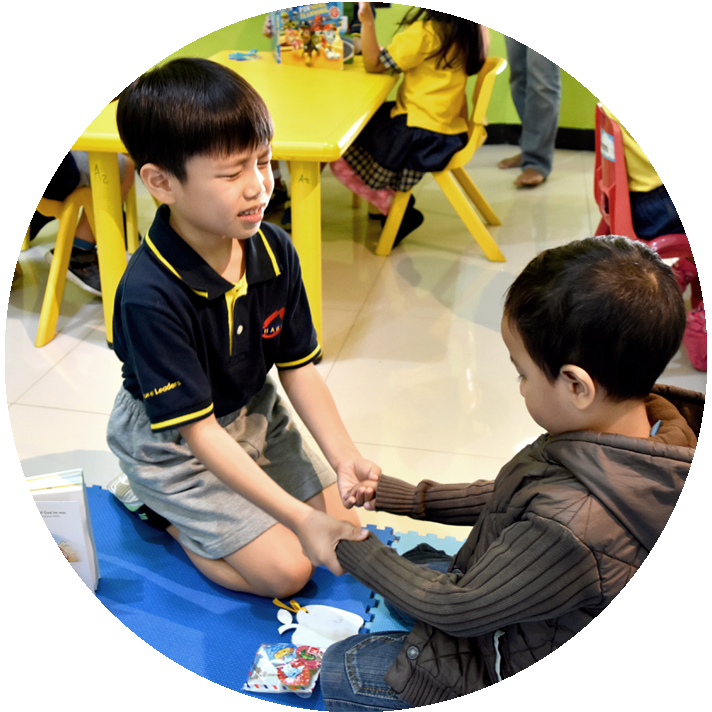
Shortly after beginning her work for prison boys, she established similar houses for little girls. Today, under her care and support are more than 400 children in 12 orphanages and homes.

The question naturally arises: How does one small woman, however energetic, manage to supervise so many varied operations? The answer lies in her faculty for facing the formidable with an indomitable faith, plus a capacity for infecting others with her own limitless compassion. Besides a staff of 15 young Formosans who are the only paid workers at the big warehouse which is her headquarters in Taipei, she has the aid of hundreds of part-time volunteers. Since she takes no salary for herself and most aides are volunteers, she operates with less than a two-percent overhead.

Lillian Dickson’s faith is simple and direct. In beginning a new project for which there are no funds, she tells her workers, “Let’s start it anyway. If God wants it done, He’ll provide for it somehow.”

And example she cites of what happens when one “gets set for a miracle” was the unexpected way that help came when she conceived the idea of and occupational-therapy building at the leprosarium. On a visit to the United States, she took the project to Dr. Daniel A. Poling of Christian Herald, which operates its own charities. “I wish I could help you,” said Dr. Poling, “but our contributors earmark their gifts for rather specialized projects.

The next day Dr. Poling received word that Christian Herald charities had been left a $16,000 legacy for “leprosy work.” He summoned Mrs. Dickson to say, “We have no leprosy work, so you must help us. God must have been listening to our conversation yesterday.”

Although agencies and missions have taken over full or partial support of most of the projects Mrs. Dickson has started, her work’s main support comes from individuals and local church groups in Canada and the United States. With these correspondents — some 20,000 of them at present — she shares her experiences and her hopes in a chatty monthly letter. Those who respond are told exactly what their gifts will buy. Contributors receive pictures of the children they “adopt,” patients they sponsor, churches or equipment they buy.

Years ago Lillian Dickson incorporated her work as “The Mustard Seed, Inc.” Her choice of name refers to a passage in the New Testament: “If ye have faith as a grain of mustard seed, ye shall say unto this mountain, remove hence to yonder place, and it shall remove; and nothing shall be impossible unto you.” The name seems singularly apt.